
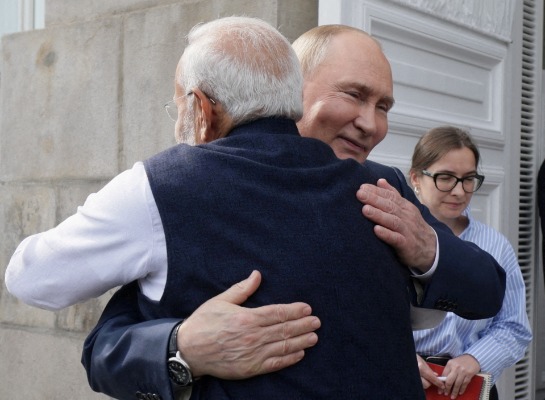
As global geopolitics are experiencing tectonic shifts, India is trying to negotiate its strategic triangle with Russia and the US. New Delhi has had a strong defense and energy relationship with Moscow in the past, but is also bringing Washington into the relationship, especially with increasing tensions with Russia, considering its war in Ukraine. How India manages and balances these relationships will have significant implications for global diplomacy and regional security in South Asia.
Historical Context and Current Support
India's relationship with Russia has historical roots, dating back to the Cold War, when Moscow has historically provided India with 60% of India's defense apparatus. Since the sanctions against Russia in 2022 by Western states for its invasion of Ukraine, India has continued to purchase Russian military hardware, such as the S-400 missile defense systems [1]. This reliance on Russia is indicative of a broader autonomy strategy that New Delhi pursues while remaining nonaligned with either bloc of power internationally.
India has also enhanced its strategic partnership with the United States through the new Quadrilateral Security Dialogue (Quad) with Australia and Japan. Recent joint military exercises and increased defense technologies transitions reflected Washington's commitment to treating India as a counterbalance to China's growing aggressiveness [2]. The U.S. is still India's second-largest trade partner, showing the increasing interdependence between these two economies.
The Energy and Diplomatic Balancing Act
Energy security has further complicated India's situation. With Russia now offering discounted oil and natural gas in response to sanctions, India has now become one of Moscow's key buyers by 2025, importing almost 800,000 barrels per day, which is greater than what the usual producers in the Persian Gulf region sell [3]. The West has chided the approach and sees India's purchase as something negative, contributing to the sanctions regime.
In regards to diplomacy, New Delhi has pursued a more deft approach: by abstaining from UN votes condemning Russia, New Delhi is advocating for peaceful means of resolution but also respect for international law [4]. This balancing of neutrality is intended to harness India's strategic options whilst maintaining its relations with the West and not upsetting its long-standing relationship with Russia.
Regional and Global Repercussions
In a larger context, India has an important position in providing stability for South Asia. India can maintain a relationship with Russia, which allows it to access key military technologies, while the relationship with the U.S. will allow India to broaden its capacity to deter threats from regional rivals, notably threats from China and Pakistan. These same relationships allow India to have an impact on larger spheres of international relations, such as BRICS and the Shanghai Cooperation Organization, both of which have a loud voice through Moscow and Beijing.
This form of balancing act is also part of a broader trend with emerging powers displaying autonomy from the great power rivalries and indicating multipolarity characterizing a new world order driven by pragmatic rather than ideological diplomacy.
Events that we Anticipate
India's task will be to maintain its current position, as the pressure brought on by maintaining it will only increase. The U.S. will want India to take greater action against Russia, and Moscow will be looking to upgrade its relations with non-Western partners. With India's policy choices being scrutinized, from now on, the organization looks different, and the agendas and the narrative will be altered. In the future, it will be possible to exploit its geostrategic significance while also contributing to the resolution of conflict and global stability.
[1] Stockholm International Peace Research Institute, “India-Russia Defense Trade Report,” 2025
[2] U.S. Department of Defense, “Joint Military Exercises with India,” 2025
[3] International Energy Agency, “Global Oil Trade Flows,” 2025
[4] United Nations General Assembly Voting Records, 2024-2025
[5] Image Source: https://eastasiaforum.org/2024/08/22/india-picks-its-friends-as-it-treads-between-russia-and-the-west/